

“Contact with the Desert” – Account and Testimony of a 4x4 Expedition in the Moroccan Desert
From March 28 to April 1, a 4x4 expedition took its participants across southern Morocco, from the foothills of the Atlas to the desert tracks. At the end of the journey, one of them, F.B., recorded his experience in the form of a narrative, which we have chosen to reproduce here, staying true to the richness of his perspective and the intensity of the journey. Originally written in French, the text has been translated with an effort to preserve its spirit as faithfully as possible.

" Contact with the Desert Lessons in Driving and Humility from Southern Morocco
By F. B.
Leaving Foum-Zguid, we leave the tarmac behind and enter the desert. It is made up, our guide Jérôme tells us over the radio, of 80% ground strewn with hard rocks, and for the rest of fields of fixed dunes where only the surface sand is constantly reshaped by the wind—the ergs.
We form a convoy of five off-road vehicles that set out the previous day from Marrakech, 350 km to the north, and now veer southwest toward Lake Iriqui and the Drâa wadi. Eighty kilometers of unpaved track lie ahead of us on the way to Mhamid, their passability uncertain in rainy weather, according to the legend on the Michelin map.
"Make your own track,” the AllMoov brochure—our guide Jérôme Rivière’s independent outfit—also urges. And that is exactly what we are about to do in this area, with no guidance other than a few tire marks or cairns. The weather is beautifully clear in these last days of March.
This is the four-day, three-night format. Jérôme, with 19 Paris–Dakar rallies to his name as a team driver, is also embracing a more ecological approach, now offering non-motorized outings, such as two-wheeled electric scooter excursions, while camel rides remain an option at each stop.
The day before, leaving the capital of southern Morocco, we crossed the Tizi n’Tichka pass at an altitude of 2,260 meters and followed the national road from Ouarzazate through mountains layered with flaking textures. We looked out over deep valleys of clay and sandstone, at the bottom of which palm groves nestled along a still-moist wadi. We then turned south toward Tazenakht and, after a lunch break in Tassietift, reached Foum-Zguid, a town on whose approach the high hills lining the road still displayed harmonious undulations of sedimentary rock strata.


In the late afternoon, we were welcomed at the Bab Rimal hotel with mint tea, of course, and a long lap pool set against a backdrop of rocky ridgelines, while a little farther south, two rising landforms drawing closer together outlined the gateway to the desert. In the morning, a young vendor from the village shared his knowledge of how to tie a cheche—preferably in Berber blue. The headscarf would prove useful not only for covering the head but also the lips, helping to prevent chapping caused by the dry wind, the chergui.
We now pass a military outpost—a square enclosure a few dozen meters across, a Moroccan flag, but no sign of life, a remnant of the buffer zone created during the years of incursions by the Polisario Front. Its presence seems to suggest that we are now on our own.

A sense of unease could then have crept into our group, made up half of long-standing friends from France and half of members of a Spanish-Moroccan family. Yet we place full trust in our guide, whom we have taken to calling “Monsieur Jérôme” at the hotel.
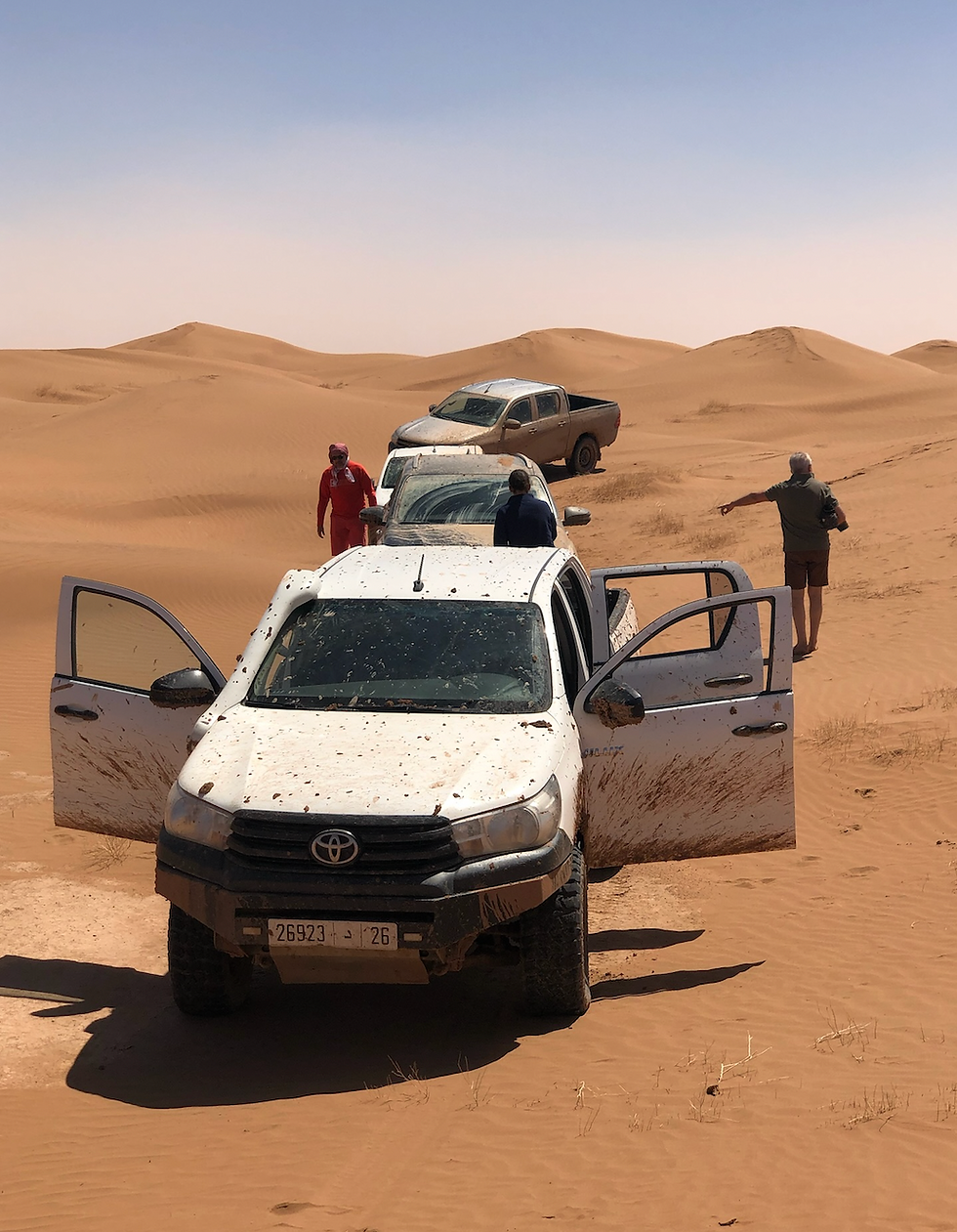
The mud feared by him after the rains that had fallen in previous weeks soon makes its appearance, once we have crossed a makeshift ford. While we had initially moved closer to the hills north of the Djebel Bani, and to the supposedly dry ground at its base, the decision to head south—where the vehicles of another expedition were travelling long, straight tracks—turns out to have been risky. Several 4x4s become bogged down. A tow strap must then be attached to one of the vehicles still on firm ground in order to pull them out one by one in reverse gear and free them from the mire, a brown stretch of terrain we had clearly seen coming but whose lack of consistency we had underestimated.

We have almost covered forty kilometers when we spot, about a hundred meters to the right, a driver who has stepped out of his bogged-down vehicle. He has a cup in his hand.
“We can’t do anything for him,” Jérôme tells us. In fact, the stranded man is not calling for help. He continues to drink, no doubt waiting for assistance from his companions—the Spaniards who had stopped the previous day at the same hotel as we did.
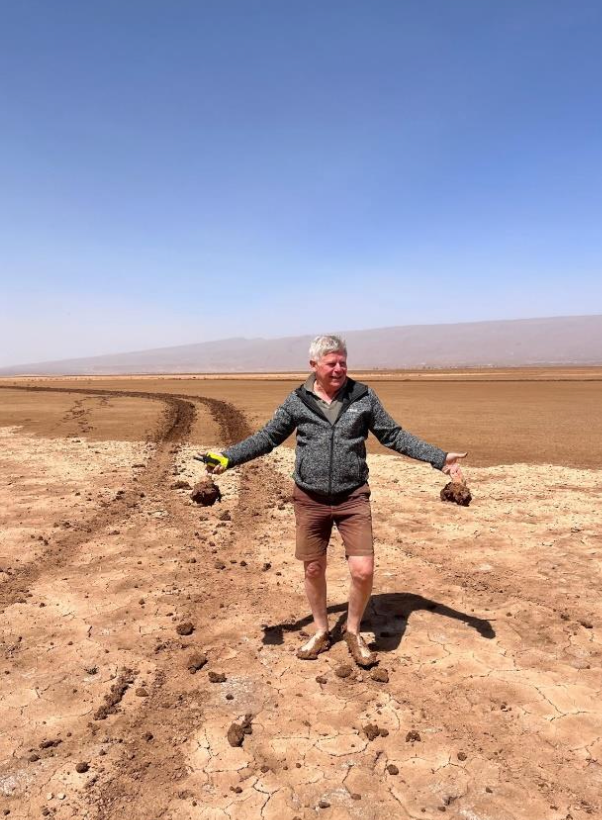
Clumps of shrubs dot the track—tamarisks, acacias whose very long roots seek out underground water. The mud is clayey, forming deposits that time will transform into very fine-grained shale.
The lunch break, halfway through today’s stage, takes place at the foot of the highest dune in Morocco. The most courageous among us will go on foot to measure its height: 93 meters—lower than the Dune of Pilat, yet at a higher altitude above sea level, at 300 meters.

In the solid-built toilets of the bivouac, several stacked sound systems are plugged into the mains to be recharged. One then thinks of the film Sirāt (2025) and the possibility that the tribe owning the place might privatize it for parties, or even for ravers in search, as in the film, of confrontation with the emptiness of the desert.
The track is resumed after the couscous. New troubles await the convoy on the uncertain route, which only the guide can read through the color of the ground or the slope of the terrain. There are fresh boggings-down while crossing Lake Iriqui, punctures, and, to top it all off, a breakdown of the convoy’s only electric vehicle. Adil, the mechanic, opens the bonnet and inspects various parts and circuits, but it is a group of four Berbers passing by in a 4x4 who ultimately save the situation. The eldest among them embraces his old friend Jérôme, then in turn goes under the bonnet, then beneath the engine, taps the starter, and… the vehicle comes back to life.
Our rescuers go on to do even more: they guide us in the falling darkness, the sun setting like a large orange globe in the center of our rear windshields. The drivers of our vehicles then only have to watch the pace of the vehicle in front, whose jolts warn of the traps of the track.

At the bivouac, the communal meal is an opportunity to meet Nagi, our host, whose family owns the establishments of our last three stops. Jérôme met him nearly thirty years ago, when he was only fifteen. In Mhamid, Nagi had approached him, telling him he had a bivouac in the desert. Jérôme had followed him and found two tents in which to sleep. He is his “father of the heart.” Nagi nods, his smile revealing the striking white teeth of his childlike face. We will learn the following day that he also owns around thirty camels; the English couple present at the dinner the previous evening set off into the desert on two of them, accompanied by an employee.
After a brief moment of gnawa music by the fire, offered by young men from the bivouac—one of them, fortunately, even playing the single-string instrument, the imzad—the night becomes an opportunity to experience absolute silence.
Such places in the world are now rare where this is possible: no traffic noise, no airplanes, not even animal cries. The kinds of beetles seen earlier on the sand make no claim to produce any sound.

Carpooling, sharing the wheel, and communal meals are of course conducive to exchanges. At breakfast, Zakaria—who belongs to a branch of the royal family descended from the same seventeenth-century sultan—gives, at the request of his fellow expedition members, a brief talk on the history of relations between Morocco and Algeria; the border lies some fifteen kilometers away.
The third day is, however, devoted to driving—if not in the dunes, then at least in the small dunes—as the expedition’s program does not allow entry into the Erg Chegaga and its high sand dunes.
Once the bivouac is left behind, we switch off the engines and step out of the vehicles to listen, standing by the track, to a lesson from Jérôme. Drive straight, accelerate all the way up the slope in second gear after selecting low range under the steering wheel, then decelerate at the summit to remain glued to the incline and ride it as if on skis (because of the loss of traction at the top, a constant speed prevents stalling). Consistency and concentration are the key principles. If you stop on a slope, reverse and attempt the ascent again.
Each of us will in turn experience getting bogged down at the crest.
Everyone then puts their hands to the sand to push, at the guide’s request, after an initial shovel-full.
Sand can bind people together, but it can also drive couples apart. One of the drivers will step out of their vehicle, another will ask all passengers to get out. The women at the wheel show remarkable energy—among them Zineb, the young Spanish woman who has only just obtained her driving license in her home country. It is best to leave them at it. Jérôme confirms that he frequently witnesses arguments between partners, one or the other issuing a stream of instructions—right, left, go on, accelerate…

Leaving the erg, we return to the tarmac, pass through the town of Mhamid, and stop at a hotel-restaurant set in the enchanting palm grove of Zagora, with its garden of ancient date palms and pomegranate trees.
In the afternoon, we are to rejoin the mountains of the Djebel Jani and follow the upper reaches of the Drâa valley and its fields of palm trees for nearly a hundred kilometers, once again crossing gorges of schist, before, at the entrance to the urban area of Ouarzazate, turning west toward a small valley at the bottom of which lies our overnight stop, the Ouednoujoum ecolodge.


We are welcomed there with music by a quintet of percussionists playing the bandir, and for some of us, still with our bags on our backs, we find ourselves again at the center of a circle where Gnawa music places those to be healed or animals to be sacrificed. Couples too are surrounded, as if to receive encouragement. The most agile, like Olivier, are invited to imitate the movements of a wild cat, as in an African tradition illustrating the suffering experienced in slavery—something Hamid Qabbal notes in his book The Spirit of a City (Sefrioui Editions, 2008). No shackles are placed on our friend’s feet for him to free himself from; he will manage to express, without props, the frenzy of liberation. In the evening, to enliven the meal, two women join the musicians and move between the tables, emitting ululations while shaking their tongues, mouths open, forming circles once again.
Jérôme has met a new group of clients at the ecolodge, and it is without him or Adil, the mechanic, that we will head back toward Marrakech the following day, under the guidance of Chloé, AllMoov’s communications consultant, and a driver hired for the occasion.
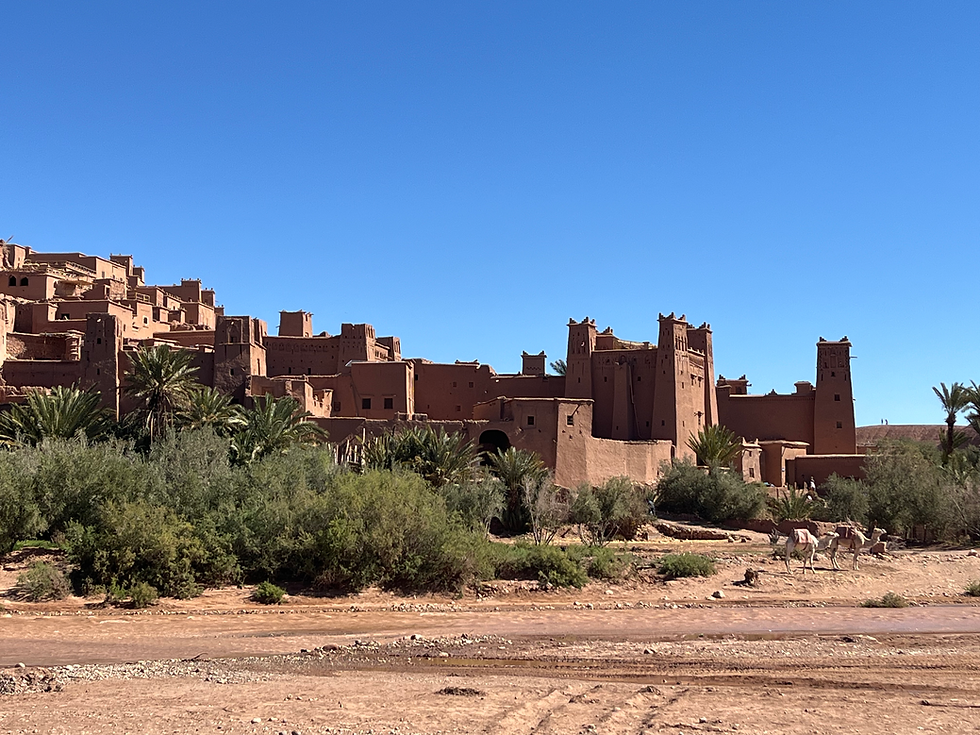
At Aït Ben Haddou, we will walk up to the top of the village to the ksar, the building that once served as a granary for storing provisions safely. We will wander through the alleys lined with painting vendors, as well as reminders of films shot there—such as Lawrence of Arabia (1954) or Ali Baba and the Forty Thieves (1954). In Telouet, under the guidance of a local guide, we will visit the kasbah, the former palace of the Glaoui, the “sultan of Marrakech,” which miraculously survived the September 2023 earthquake and still offers the remarkable sight of its grand chamber, with a carved stucco ceiling and walls covered in zellige tiles.
Entering the outskirts of Marrakech in the late afternoon feels surreal after the desert crossing, with other vehicles and motorbikes suddenly appearing from right and left without indicators and in blatant disregard of right-of-way rules. Driving in the “capital of the south of Morocco” is an experience in itself. Yet one must acknowledge in Moroccans an astonishing ability—not so much courtesy as an art of avoiding one another, as in the souks where bicycles and scooters weave their way through without ever striking a pedestrian.
We pass in front of La Mamounia, a landmark in the weaving of ties between French and Moroccan dignitaries, and soon leave the vehicles in a parking area, where they will once again return to their role as mere auxiliaries of entry—if not into paradise, then into the nothingness of the desert.
ALLMOOV’s flagship product is the circuit leading from the High Atlas to the vast Saharan expanses, a 4x4 itinerary. It is meant to concentrate the very essence of southern Morocco. Designed as a supervised adventure, it allows participants to “discover the desert by understanding the terrain, learning how to traverse it, and enjoying carefully selected locations, without having to deal with the complexity of the journey.”
The agency also offers raids on e-tt or e-vtt (electric scooters and electric mountain bikes).
Contact : info@allmoovmarrkech.com
"
F. B. is the author of the narrative Un thé avec Sarah, a work structured as a narrative projection, conceived prior to the 4x4 circuit.


Comments